
Enterprise Software Development Cost: 9 Factors Explained
The honest answer to "how much will it cost?" is "it depends on scope" — but the factors that set the scope are known. We cover the nine factors that drive the price, person-day math, fixed-price versus time-and-materials contracts, and the line items that never show up in proposals.
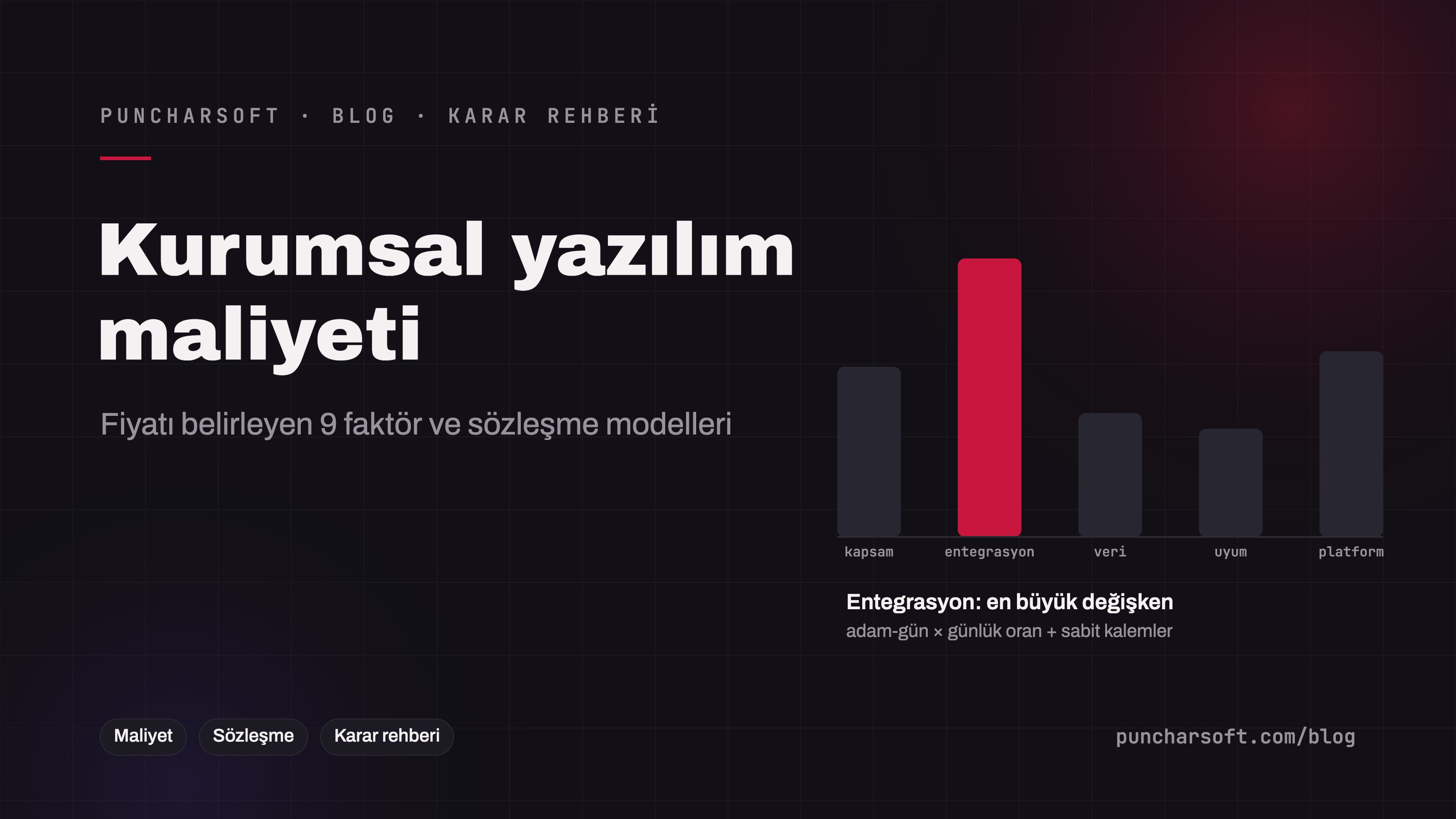
The first question in every discovery call is the same: "How much will it cost?" The honest answer is "it depends on scope" — but that answer alone is useless. The factors that set the scope, and therefore the price, are known, measurable and largely controllable before you ask for a proposal. This article covers those factors, the person-day math behind proposals, the difference between contract models, and the line items that don't appear in proposals. We don't give numbers; we show you how to read them.
The nine factors that determine the price
# | Factor | Effect on cost | How to control it |
|---|---|---|---|
1 | Scope: number of roles, screens and business rules | Linear; the most visible item | Draw the process as a flow; separate "must have" from "nice to have" |
2 | Integration: number and nature of systems to connect | The biggest variable; a system without an API costs 3–5× more | Is there API documentation for each system, and which way does data flow? |
3 | Authorization: role hierarchy, approval flows, data visibility rules | Grows quickly with the number of rules | Prepare the role matrix before discovery |
4 | Data migration: moving and cleaning existing data | Often skipped; 15–25% of project time with dirty data | Share a sample of the source data early |
5 | Regulation and compliance: privacy law, e-invoicing, audit trail, retention | Fixed extra cost; redesign if added later | Write compliance requirements into the specification |
6 | Performance and scale: concurrent users, data volume, response time | High targets raise architecture and test cost | Give realistic targets: "50 concurrent" and "5,000 concurrent" are different architectures |
7 | Number of platforms: web, iOS, Android, desktop | Each extra platform adds 30–60% | One platform in the first release; evaluate cross-platform options |
8 | Design depth: corporate template vs bespoke interface | Bespoke UX adds 10–20% | Decide by user count and external visibility |
9 | Client-side capacity: approval speed, change rate, product owner | Waiting and rework; the main cause of delays | Assign a product owner; put decision time in the contract |
Two of these nine factors explain most of the difference between proposals: integration and data migration. Writing code is predictable; discovering another system's behavior and cleaning ten years of data is not. If a proposal doesn't show these two items as separate lines, it was either priced on assumptions or the cost will arrive later as additional work.
The math behind proposals: person-days
Every proposal, whether it says so or not, comes from this formula:
Cost = team size × duration × daily rate + fixed items
A typical enterprise project team looks like this: one analyst/project manager (part-time), two or three developers, one UI designer (heavy at the start), one tester (heavy at the end). Duration bands depend on scope: a focused enterprise module typically takes 8–12 weeks; an integrated, multi-role platform 4–9 months. Duration is driven less by the amount of code than by the number of integrations and the complexity of approval processes.
The easiest way to sanity-check a proposal is to ask for the person-day count. "A 12-week project with a 2.5-person team" is roughly 150 person-days; divide the proposal price by 150 and the resulting daily rate can be compared with the market range. A proposal without a person-day breakdown cannot be compared.
Contract models: fixed price, time and materials, hybrid
Dimension | Fixed scope – fixed price | Time and materials (T&M) | Hybrid |
|---|---|---|---|
Scope clarity | Must be high; written specification required | Can be low; scope firms up along the way | Discovery fixed price, development T&M |
Who carries the risk | The vendor; a risk premium is added to the price | The client; but transparently | Shared |
Change management | Every change is a new quote | Backlog priority changes; no new contract | Per sprint |
Budget predictability | Exact | Managed with a budget cap and weekly reports | Exact per phase |
Best fit | Clear scope, work that has been done before | High uncertainty, work that needs discovery | Most enterprise projects |
Fixed price looks "safer" but has two costs: the vendor adds uncertainty to the price as a premium, and every change becomes a negotiation. In projects where the scope isn't settled, time and materials — with a budget cap and weekly progress reports — is usually both cheaper and more controllable. The structure we set up most often is hybrid: discovery and prototype at a fixed price, development per sprint, maintenance monthly.
Line items that don't show up in proposals
Maintenance and support: Annual maintenance after delivery is typically 15–20% of the development cost. Without it in the budget, the software starts to decay in year two.
Infrastructure: Cloud or servers, backup, monitoring, SSL, domain. Low per month, but continuous.
Third-party services: SMS, e-mail delivery, maps, payment provider, e-invoicing integrator. Billed by usage.
Store and certificate accounts: Apple and Google developer accounts and code signing for mobile projects.
Security testing: Penetration testing is a separate item for systems exposed to external customers.
Training and documentation: Handover training and technical documentation should be part of the proposal; otherwise they are charged later.
Data migration: Covered above; insist on seeing it as a separate line.
Right and wrong ways to reduce cost
Right ways
MVP scope: The minimum flow that runs the business in the first release; reports, secondary roles and "nice to have" features in phase two.
Ready-made components: Keycloak for identity, a provider integration for payments, an integrator for e-invoicing. Don't pay to build parts that give you no competitive advantage.
Phased integration: First a version that works with file/manual transfer, then live integration.
Prototype sign-off: No production code before the clickable prototype is approved; the most expensive change is changing a screen that has already been coded.
Wrong ways
Cutting testing and documentation: A 10% saving in the short term, paid back at the first production incident.
Skipping discovery: A price given without discovery is an estimate, not a proposal; the difference arrives later as "additional work".
Choosing the lowest bid: A threefold difference usually means the scope was understood three different ways.
Seven questions to ask when requesting a proposal
How many person-days is the proposal based on, and what is the team structure?
Are integration and data migration separate lines?
What assumptions was it priced on, and under which conditions does the price change?
Who owns the source code, and at what point is it transferred?
What is the scope of the maintenance contract and the response-time commitment?
How will acceptance criteria be defined, and what will delivery be approved against?
How will change requests be priced and prioritized?
Frequently asked questions
Why do proposals for the same job differ threefold?
Mostly because the scope was understood differently: one included integration, the other didn't; one priced testing and documentation, the other didn't. Don't compare proposals without asking for person-days and an assumption list.
Is fixed price always safer?
If the scope is settled in a written specification, yes. If it isn't, fixed price usually ends up more expensive because of the risk premium and change negotiations; capped time and materials is more controllable.
Is a maintenance contract mandatory?
Not mandatory, but unavoidable: security patches, library updates and regulatory changes must be someone's responsibility. If your own team will take over maintenance, make handover training and documentation part of the delivery.
Conclusion
Enterprise software cost is not a price list; it is the result of nine factors and the chosen contract model. Drawing the scope as a flow, seeing integration and data migration separately, asking for person-days and budgeting maintenance from the start — these four habits remove most surprise costs.
To settle your project's scope and budget range together, see our enterprise application development process, and for post-delivery coverage our maintenance and support service. The discovery call and first estimate are free.